
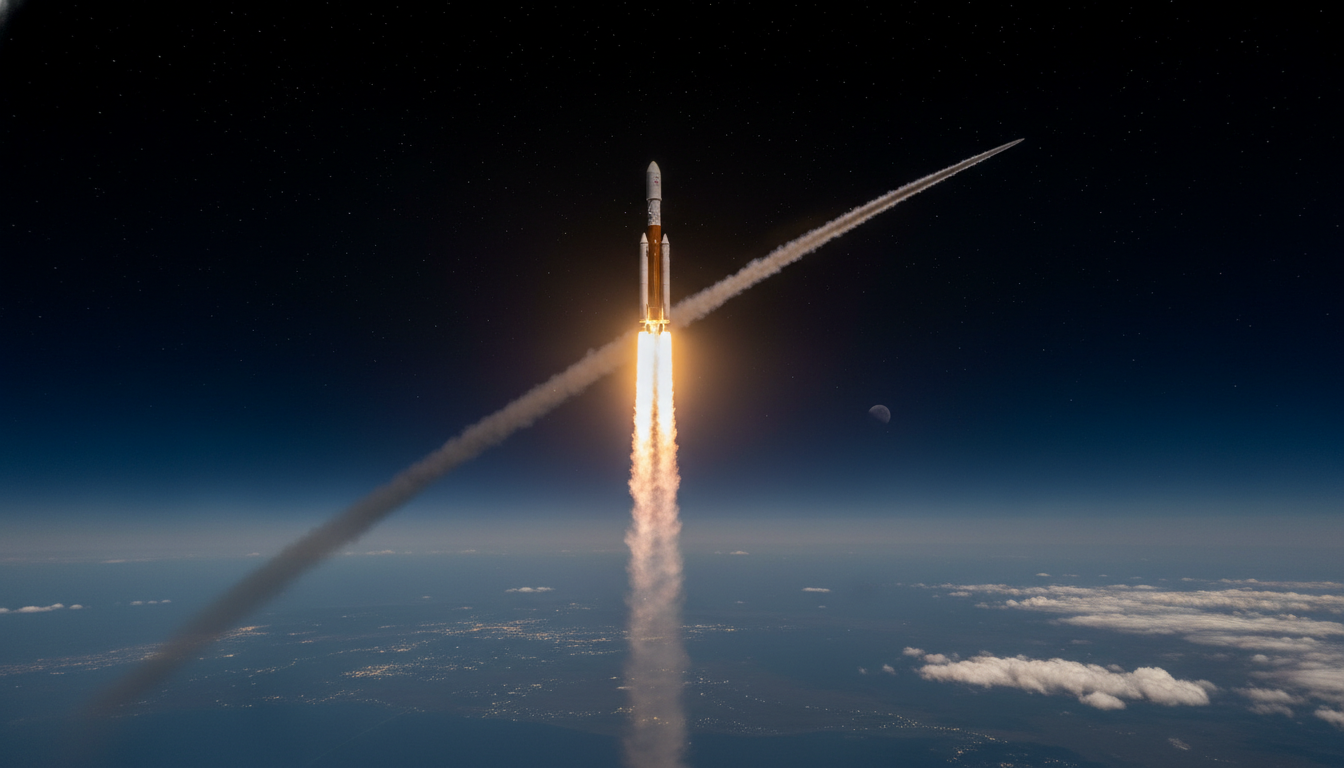
The dawn of a new era in human space exploration arrived with a deafening roar that shook the Florida coast, as NASA’s Artemis II mission finally took to the skies. Decades after the Apollo program left its final boot prints in the lunar dust, humanity has once again set its sights on our nearest celestial neighbor. For the four astronauts strapped inside the Orion spacecraft, years of rigorous training culminated in a brief, intense, and flawless sequence of events. While the entire mission to the Moon and back will span over a week, the most critical, nerve-wracking, and awe-inspiring moments unfolded in just the first twelve minutes. From the ignition of the most powerful rocket ever built to the silent glide into Earth orbit, every second was a testament to human ingenuity and the relentless pursuit of the unknown.
The Final Countdown and Ignition
As the countdown clock ticked into the single digits, the tension at Kennedy Space Center’s Launch Control was palpable. The Space Launch System (SLS), a towering behemoth of modern engineering, stood venting cryogenic gases, ready to unleash millions of pounds of thrust. At T-zero, the four RS-25 engines at the base of the core stage ignited, followed fractions of a second later by the twin solid rocket boosters. The resulting explosion of light and sound was magnificent. Generating an unprecedented 8.8 million pounds of thrust, the SLS rocket began its slow, majestic ascent from Launch Pad 39B, turning night into day and sending shockwaves that could be felt miles away.
For the crew inside the Orion capsule, the sensation was unlike anything experienced on Earth. The sheer violence of the liftoff pressed them firmly into their seats, subjected to mounting gravitational forces as the rocket fought the pull of the planet. Within seconds, the launch vehicle cleared the tower, executing a precise roll program to align itself on the correct azimuth for its lunar trajectory. The journey back to the Moon had officially begun, and the clock was ticking on a carefully choreographed sequence of automated milestones.
Surviving Maximum Dynamic Pressure
Just over a minute into the flight, the Artemis II vehicle approached one of its most critical aerodynamic checkpoints: Maximum Dynamic Pressure, commonly known as Max Q. This is the point in the ascent where the aerodynamic stress on the rocket is at its absolute highest, representing a delicate balance between the increasing velocity of the vehicle and the decreasing density of the Earth’s atmosphere. To ensure the structural integrity of the SLS, the main engines briefly throttled down, reducing the strain on the massive rocket before throttling back up to full power once the danger zone was cleared. For observers on the ground, the rocket was now a brilliant star piercing the upper atmosphere, leaving a massive, glowing contrail in its wake.
Shedding Weight for the Journey
At approximately two minutes and twelve seconds into the flight, the twin solid rocket boosters, having exhausted their incredibly potent solid propellant, had done their job. Explosive bolts fired, and aerodynamic forces smoothly peeled the 177-foot-tall boosters away from the core stage. This separation marked a significant shift in the ride profile for the astronauts. The aggressive, bone-rattling vibration characteristic of solid rockets gave way to the much smoother, albeit still incredibly powerful, acceleration of the liquid-fueled core stage engines.
Now flying high above the stratosphere, the sky outside Orion’s windows transitioned from a deep blue to the absolute black of space. The core stage continued its relentless burn, consuming hundreds of thousands of gallons of liquid hydrogen and liquid oxygen. The crew experienced a steady buildup of G-forces, peaking at around four times the force of Earth’s gravity, as the rocket became lighter and lighter, burning through its massive fuel reserves at an astonishing rate of several tons per second.
Main Engine Cutoff and Weightlessness
Approaching the eight-minute mark, the defining moment of the ascent phase arrived. The four RS-25 engines, having pushed the spacecraft to speeds exceeding 17,000 miles per hour, suddenly fell silent. This event, known as Main Engine Cutoff (MECO), was immediately followed by the separation of the massive orange core stage. For the Artemis II crew, the crushing weight of acceleration vanished in an instant, replaced by the sudden, serene sensation of microgravity. Pencils, checklists, and the mission’s zero-gravity indicator began to float freely within the cabin, signaling their safe arrival in the vacuum of space.
Powering the Orion Spacecraft
With the core stage falling away to a fiery reentry over the Pacific Ocean, Orion was left attached only to the Interim Cryogenic Propulsion Stage (ICPS), the upper stage that would eventually provide the crucial push toward the Moon. However, before that translunar injection could occur, the spacecraft needed to secure its own power source. At around the twelve-minute mark, the Orion spacecraft deployed its four distinct solar array wings. Unfolding like a mechanical origami bird, the arrays stretched out to capture the unfiltered energy of the sun, ensuring that the life support, navigation, and communication systems would remain fully operational for the duration of the deep space voyage.
This deployment marked the end of the initial, frantic launch phase. The spacecraft was now safely in a preliminary Earth orbit, coasting silently above the blue marble. Mission Control in Houston took over primary communication, initiating a comprehensive checkout of all systems. The astronauts unstrapped from their seats, floating to the windows to gaze down at the Earth—a view that only a handful of human beings have ever witnessed. The chaotic violence of the launch was a stark contrast to the peaceful silence of orbit.
The successful execution of those first twelve minutes serves as the foundational triumph of the entire Artemis program, a brief window of time where physics, engineering, and human courage converged flawlessly. As the Orion spacecraft glides through the silent expanse of its parking orbit, awaiting the engine burn that will fling it across the void toward the Moon, the significance of the achievement echoes back on Earth. The roar of the rockets has faded, but the momentum of that ascent carries the dreams of a new generation outward, proving that the boundaries of our world are merely the starting line for the next great voyage into the cosmos.