
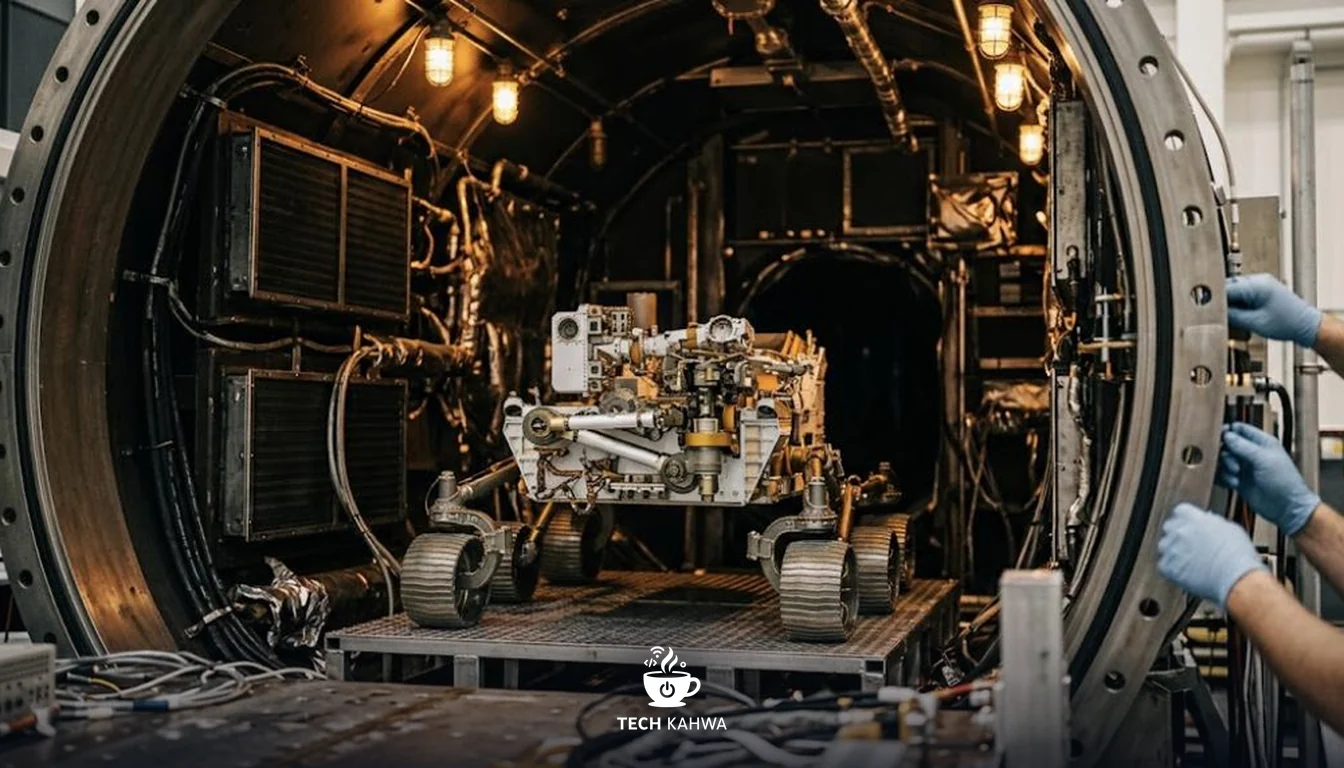
The Mohammed Bin Rashid Space Centre (MBRSC) announced on 3 November that development of Rashid Rover 2 is complete in the UAE, and the rover is now heading to the United States for its next phase with Firefly Aerospace. Its target is the far side of the Moon, a region spacecraft rarely visit, and it will ride there on Firefly’s Blue Ghost lander.
What happened
According to the Dubai Media Office, MBRSC wrapped up the build and the full test campaign for Rashid Rover 2 inside the UAE. The next step takes place in the US, where the rover will be prepared for integration with Firefly’s Blue Ghost lander.
This is the UAE’s second lunar rover. The first Rashid rover flew aboard ispace’s Hakuto-R Mission 1 lander, and was lost when that landing failed in 2023. Firefly announced in May 2025 that it had added Rashid 2 to its Blue Ghost mission to the far side of the Moon, and the project is funded by the ICT Fund of the UAE’s Telecommunications and Digital Government Regulatory Authority (TDRA).
MBRSC chairman Hamad Obaid AlMansoori said: “The completion of the development of Rashid Rover 2 in the UAE stands as a testament to our nation’s advancing capabilities in space science.”
What I like about this announcement is where the work happened. The rover was designed, built and tested through a chain of partners, and the milestone being celebrated is that the development phase closed out in the UAE itself.
How it works: proving a rover before it flies
A rover cannot be repaired once it leaves Earth, so every part has to be shown to survive the trip and the destination before launch. Think of it like crash-testing a car, except the “crash” includes a rocket ride, a vacuum, and brutal swings between heat and cold.
Rashid Rover 2 went through four main kinds of tests, according to the Dubai Media Office:
- Thermal vacuum testing at France’s space agency CNES in Toulouse. A thermal vacuum chamber pumps out the air and cycles the temperature, so engineers can see how electronics, batteries and materials behave in conditions close to space.
- Solar panel tests under simulated lunar conditions, to confirm the panels can generate the power the rover needs on the surface.
- Deployment tests at simulated lunar gravity for the antenna and the robotic arm. The Moon’s gravity is much weaker than Earth’s, and moving parts that unfold have to work correctly under that lighter pull.
- Vibration testing at EARTH, a subsidiary of the UAE’s EDGE Group. This shakes the rover the way a rocket launch would, to make sure nothing loosens or cracks.
Passing all four does not guarantee success on the Moon, but it removes many of the known ways a mission can fail before it ever leaves the ground.
By the numbers
| Item | Figure | Source |
|---|---|---|
| Development completion announced | 3 November 2025 | Dubai Media Office |
| Main test campaigns completed | 4 | Dubai Media Office |
| Thermal vacuum test site | CNES, Toulouse, France | Dubai Media Office |
| Vibration test site | EARTH, an EDGE Group subsidiary | Dubai Media Office |
| Firefly adds Rashid 2 to Blue Ghost far side mission | 22 May 2025 | Firefly Aerospace |
| Year the first Rashid rover was lost | 2023 | Wikipedia |
| Target landing region | Far side of the Moon | Dubai Media Office; Firefly Aerospace |
Why it matters
The first Rashid rover never got the chance to drive, because the lander carrying it failed. Building a second rover and taking it through a complete test campaign shows the programme did not stop at one setback.
The choice of destination raises the stakes. The far side of the Moon always faces away from Earth, and few missions have gone there. Aiming an Arab-built rover at that region is an ambitious move, and in my view it says more about the programme’s confidence than a safer near side target would.
For the region, the milestone is also about skills. Test work done with partners in France and at EARTH, part of the UAE’s EDGE Group, builds experience that stays in the country for future missions.
What comes next
With development finished, Rashid Rover 2 moves to the United States for the next phase with Firefly Aerospace, where it will be prepared for integration with the Blue Ghost lander. MBRSC and Firefly have not set out a launch date in this announcement, so the next public milestone to watch is the integration work itself.
For now, the rover has cleared its tests at home and is on its way to the team that will carry it to the Moon.
Sources
- Dubai Media Office, “Rashid Rover 2 completes development in the UAE”, 3 November 2025, https://mediaoffice.ae/en/news/2025/november/03-11/ashid-rover-2-completes-development-in-the-uae
- Firefly Aerospace, “Firefly Aerospace adds UAE’s Rashid 2 rover to Blue Ghost mission to the far side of the Moon”, 22 May 2025, https://fireflyspace.com/news/firefly-aerospace-adds-uaes-rashid-2-rover-to-blue-ghost-mission-to-the-far-side-of-the-moon/
- Wikipedia, “Blue Ghost Mission 2” entry (background on the first Rashid rover), undated encyclopedia entry, https://en.wikipedia.org/wiki/Blue_Ghost_Mission_2