
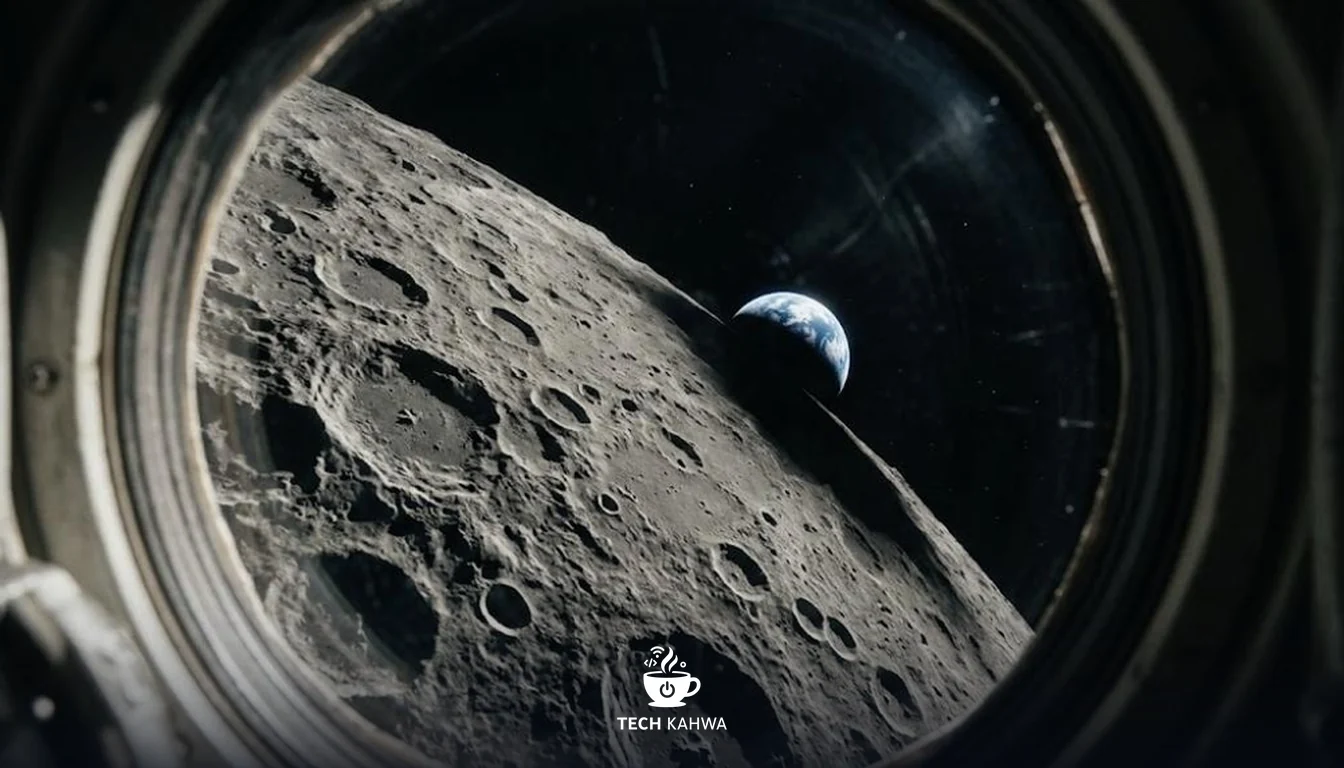
Four astronauts aboard NASA’s Orion spacecraft flew around the Moon on 6 April and, on the way, broke the Apollo 13 record for the farthest distance humans have ever travelled from Earth. That record had stood since 1970, and Artemis II is the first crewed flight of the spacecraft NASA plans to use for future trips to the Moon.
What happened
Artemis II lifted off on 1 April 2026 at 6:35 p.m. EDT (22:35 UTC). On board are NASA astronauts Reid Wiseman, Victor Glover and Christina Koch, and Canadian Space Agency astronaut Jeremy Hansen. It is the first time Orion has carried a crew.
Five days later, on 6 April, the crew passed the mark set by Apollo 13, which reached 248,655 miles from Earth in 1970. NASA said Orion was expected to reach approximately 252,756 miles from Earth at its farthest point, a new record for the greatest distance people have travelled in space.
The flyby itself brought the spacecraft to about 4,067 miles above the lunar surface at its closest. NASA also planned for a communications blackout of about 40 minutes while Orion was behind the Moon, cut off from contact with Earth.
What caught my attention is that the record fell on a test flight. The main purpose of Artemis II is to check a spacecraft with people aboard, yet along the way it rewrote a number that had stood for more than half a century.
How it works
Artemis II is not a landing mission. The crew’s job is to fly Orion out to the Moon, loop around it, and prove that the spacecraft and its systems work with people inside. The distance record is a side effect of the route: as Orion swings around the far side of the Moon, it is not only near the Moon but also on the side facing away from Earth, which pushes it to its greatest distance from home.
The communications blackout follows from simple geometry. Radio signals travel in straight lines, so when the Moon sits directly between the spacecraft and Earth, there is no path for the signal. Think of driving behind a mountain and losing your phone signal until you come out the other side. NASA plans for this in advance, which is why the roughly 40-minute window was known before the flyby.
The low pass over the surface, about 4,067 miles, gives the crew a close view of the Moon while keeping the spacecraft on a path that brings it back towards Earth. In effect, the whole spacecraft is being tested in the kind of conditions a future crew would face on the way to a landing.
By the numbers
| Item | Figure | Source |
|---|---|---|
| Launch | 1 April 2026, 22:35 UTC | Wikipedia |
| Crew | 4 astronauts | NASA |
| Apollo 13 distance record, 1970 | 248,655 miles from Earth | NASA |
| Orion’s expected farthest distance | About 252,756 miles from Earth | NASA |
| Closest pass above lunar surface | About 4,067 miles | NASA |
| Planned communications blackout behind the Moon | About 40 minutes | NASA |
Why it matters
The obvious answer is the record, but I think the more important part is who was on board and what they were flying. This is the first time astronauts have ridden Orion, and it is the first time in the Artemis programme that people have travelled to the Moon’s vicinity. A capsule that has only flown uncrewed is a promising machine. A capsule that has carried four people around the Moon is something a space agency can plan real missions around.
The crew itself also tells a story. Jeremy Hansen of the Canadian Space Agency is flying alongside three NASA astronauts, a reminder that deep space exploration is increasingly an international effort rather than a single-country project.
And in my view, there is value in simply showing that humans can still do this. For decades, the farthest humans travelled was a figure from 1970. That has now changed.
What comes next
With the lunar flyby complete, the crew’s remaining task is to bring Orion home safely, and the data they collect along the way will shape how NASA prepares later Artemis missions. NASA has not yet published its full post-flight figures; those will come once the mission ends.
Sources
- NASA, news release on the Artemis II crew breaking the record for farthest human spaceflight, 6 April 2026, https://www.nasa.gov/news-release/nasas-artemis-ii-crew-eclipses-record-for-farthest-human-spaceflight/
- NASA Missions blog, Artemis II flight day 6 update on the lunar flyby, 6 April 2026, https://www.nasa.gov/blogs/missions/2026/04/06/artemis-ii-flight-day-6-crew-wraps-historic-lunar-flyby/
- Wikipedia, “Artemis II”, accessed 7 April 2026, https://en.wikipedia.org/wiki/Artemis_II