
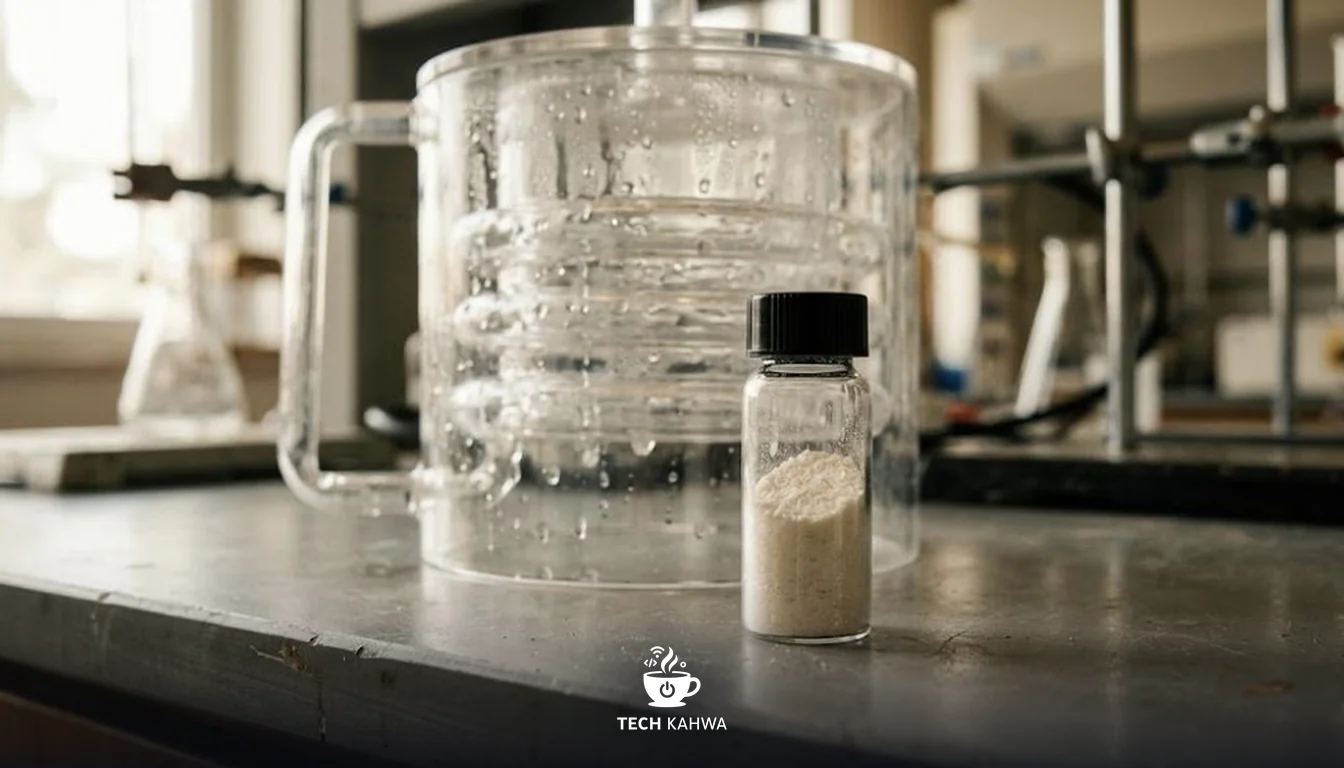
The Royal Swedish Academy of Sciences today awarded the 2025 Nobel Prize in Chemistry to Susumu Kitagawa, Richard Robson and Omar M. Yaghi “for the development of metal-organic frameworks”. These are crystals designed to be full of empty space, and the Academy lists uses ranging from harvesting water out of desert air to capturing carbon dioxide. The three laureates will share 11 million Swedish kronor equally.
What happened
The laureates work far apart: Kitagawa at Kyoto University in Japan, Robson at the University of Melbourne in Australia and Yaghi at UC Berkeley in the United States.
According to the Academy, the field traces back to a 1989 breakthrough by Robson. Since then chemists have built tens of thousands of different metal-organic frameworks, usually shortened to MOFs. The Academy’s announcement describes the materials as having “enormous potential, bringing previously unforeseen opportunities for custom-made materials with new functions”.
It is a prize for a way of building matter, more than for a single molecule or a single reaction. That is part of what makes it interesting to me.
How it works
The name tells you most of the recipe. A metal-organic framework combines metal-based building blocks with organic, carbon-based molecules that act as connectors between them. Chemists choose the pieces so that they lock together in a regular, repeating pattern, forming a crystal.
Here is the analogy I find most useful. Think of a building’s steel frame before any walls go in: joints at the corners, beams between them, and open rooms everywhere. In a MOF the metal parts are the joints and the organic molecules are the beams. What you end up with is a solid that is mostly open space, with rooms that are molecule sized.
Those rooms are where the work happens. Because chemists pick the joints and beams, they can adjust the size of the openings and the chemistry of their inner walls. Tune them one way and gas molecules such as carbon dioxide get trapped inside. Tune them another way and the crystal can grab water molecules from air, or hold on to a toxic gas so it can be stored safely. The Academy also mentions catalysing chemical reactions, and separating PFAS, a group of hard to remove pollutants, from water.
This is why “designer sponge at the molecular scale” is a fair description. An ordinary sponge soaks up whatever it touches. A MOF can, in principle, be built to take in one kind of molecule and leave others alone.
By the numbers
| Item | Figure | Source |
|---|---|---|
| Laureates | 3 (Kitagawa, Robson, Yaghi) | Royal Swedish Academy of Sciences, 8 Oct 2025 |
| Prize amount | 11 million Swedish kronor, shared equally | Royal Swedish Academy of Sciences, 8 Oct 2025 |
| Year of Robson’s founding breakthrough | 1989 | Royal Swedish Academy of Sciences, 8 Oct 2025 |
| Number of different MOFs built since | Tens of thousands | Royal Swedish Academy of Sciences, 8 Oct 2025 |
| Applications named by the Academy | 5 (desert water harvesting, CO2 capture, toxic gas storage, catalysis, PFAS separation) | Royal Swedish Academy of Sciences, 8 Oct 2025 |
Why it matters
What caught my attention was the first item on the Academy’s list of uses: pulling water from desert air. For readers in our region, where so many cities sit in dry climates, that line lands differently than it might in Sweden. I would still be careful with it. The Academy talks about potential and opportunities, and the prize does not mean MOFs are solving water shortages today. Moving from a crystal that works in a laboratory to a device that supplies a household is a long engineering road.
The same caution applies to carbon capture. MOFs are among the materials being tested for trapping carbon dioxide, and that matters for climate. But nobody should read this prize as a sign that climate change now has a material fix at scale.
What the prize does recognise, in my view, is a shift in how chemists think. Instead of searching for a natural material that happens to have the right properties, they can design a structure on paper and then build it. The fact that researchers have gone from one breakthrough in 1989 to tens of thousands of different frameworks shows how productive that idea has been.
What comes next
For the laureates, the prize money of 11 million kronor will be divided equally. For the field, the next steps are the ones the Academy points to: taking MOFs from promising laboratory results toward practical use in water harvesting, carbon dioxide capture, gas storage, catalysis and cleaning PFAS from water.
Sources
- Royal Swedish Academy of Sciences, “The Nobel Prize in Chemistry 2025”, 8 October 2025, https://www.kva.se/en/news/the-nobel-prize-in-chemistry-2025/
- Royal Swedish Academy of Sciences via nobelprize.org, press release on the 2025 Nobel Prize in Chemistry, 8 October 2025, https://www.nobelprize.org/prizes/chemistry/2025/press-release/