
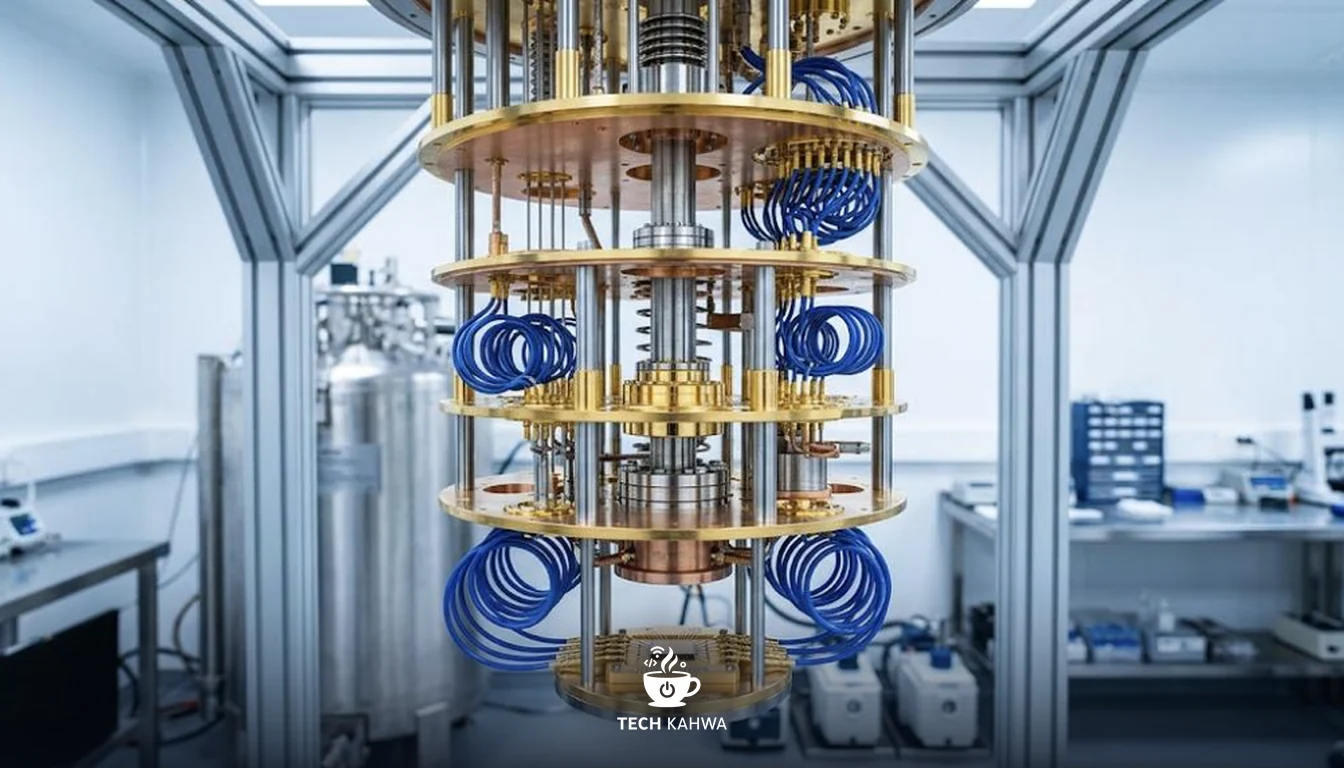
Google says its Willow quantum chip has completed a calculation called Quantum Echoes 13,000 times faster than the best classical algorithm running on one of the world’s most powerful supercomputers. The company calls it the first-ever verifiable quantum advantage, and the work is published in Nature.
What happened
On 22 October, Google’s quantum team announced the result on its blog alongside the Nature paper. The headline line is simple: “we’ve demonstrated it runs 13,000 times faster on Willow than the best classical algorithm.” The classical side of the comparison was Frontier, one of the most powerful supercomputers on the planet, according to Science News.
Willow is Google’s 105-qubit chip. For this experiment the team used 65 of those 105 qubits to measure something physicists call quantum echoes, known more formally as out-of-time-order correlators.
Google also ran a smaller proof-of-principle experiment tied to nuclear magnetic resonance (NMR), the same physics behind MRI scanners and a standard tool in chemistry labs. In that test the team “studied two molecules, one with 15 atoms and another with 28 atoms.”
What caught my attention is the word “verifiable”. Earlier quantum advantage claims mostly produced random-looking outputs that nobody could easily confirm. This time the result is meant to be something another quantum computer, or nature itself, can reproduce.
How it works
A quantum computer stores information in qubits, which can hold a blend of states at once. When qubits interact, information spreads through the whole system very quickly, a bit like a drop of ink spreading through a glass of water.
The Quantum Echoes experiment asks a clever question: if you run the system forward, nudge one qubit, and then run everything backward, how much of the original state comes back? Think of shouting into a canyon. The echo that returns carries information about the shape of the rock walls. In the same way, the echo that returns to the qubits carries information about how the disturbance travelled through the system.
Measuring these out-of-time-order correlators is extremely hard for ordinary computers, because tracking how information scrambles across dozens of interacting qubits grows expensive very fast. On Willow, the chip simply does the physics and reads off the answer.
The link to chemistry comes from NMR. Molecules also “echo” when their atomic nuclei are nudged by magnetic fields, and chemists use those signals to work out molecular structure. Google’s small two-molecule test is a first step toward using the same echo idea to learn more about real molecules.
By the numbers
| Item | Figure | Source |
|---|---|---|
| Speed versus best classical algorithm | 13,000 times faster | Google blog |
| Qubits on the Willow chip | 105 | Google blog; Science News |
| Qubits used in the experiment | 65 | Google blog; Science News |
| Atoms in the first NMR test molecule | 15 | Google blog |
| Atoms in the second NMR test molecule | 28 | Google blog |
| Classical comparison machine | Frontier supercomputer | Science News |
Why it matters
For years, the case against quantum advantage claims has been that the tasks were artificial and the answers could not be confirmed. A result that can be checked, on a problem connected to how molecules behave, answers both complaints at least in part.
In my view, this is the more meaningful kind of milestone. It moves quantum computing a step away from lab demonstrations whose only purpose is to be hard for classical machines, and a step toward tools that could one day tell scientists something they want to know.
It is also important to be clear about what this is not. It does not mean quantum computers now beat classical computers at everything. It says nothing about breaking encryption. And the NMR work is a proof of principle on two small molecules, not a drug discovery result.
There is a history of caution here too. Science News reports that MIT physicist Aram Harrow pointed out that earlier quantum advantage claims were later challenged when researchers found better classical algorithms. The 13,000 times figure is measured against the best classical method known today, and that benchmark can move.
What comes next
Google frames Quantum Echoes as a verifiable benchmark, so the natural next step is for other groups to test it: classical computing researchers will look for faster algorithms, and quantum teams can try to reproduce the measurement. The NMR experiment points to the practical direction Google wants to take, using echoes to study molecular structure, though that remains early work.
For now, the honest summary is that a quantum chip did a physics calculation much faster than a top supercomputer could, and for the first time the answer is something others can check.
Sources
- Google, blog announcement of the Quantum Echoes algorithm on Willow and verifiable quantum advantage, 22 October 2025, https://blog.google/innovation-and-ai/technology/research/quantum-echoes-willow-verifiable-quantum-advantage/
- Science News, report on Google’s Quantum Echoes experiment, 22 October 2025, https://www.sciencenews.org/article/quantum-echoes-google-computer
- HPCwire, “Google claims quantum advantage with Willow chip”, 22 October 2025, https://www.hpcwire.com/2025/10/22/google-claims-quantum-advantage-with-willow-chip/