
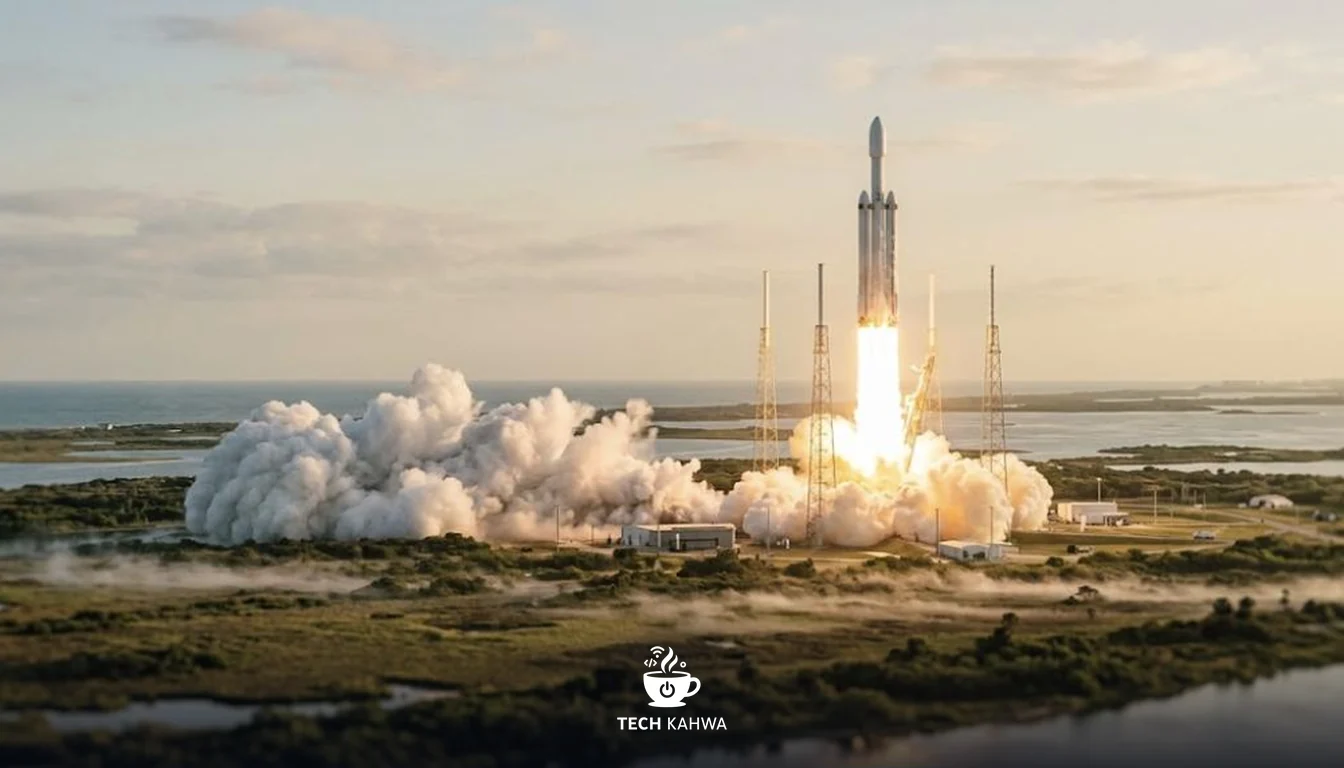
NASA’s Nancy Grace Roman Space Telescope lifted off on Sunday morning from Florida, starting a three-month trip to its observing post about a million miles from Earth. Its main camera has a field of view 100 times larger than the imaging cameras on Hubble, and the mission’s big targets are dark energy and planets around other stars.
What happened
In NASA’s words, “The mission launched at 7:26 a.m. EDT Sunday aboard a SpaceX Falcon Heavy rocket from Launch Complex 39A” at Kennedy Space Center. That was 30 August 2026, or 11:26 UTC.
Roman is now on what NASA calls “a three-month, million-mile journey” to the second Sun-Earth Lagrange point, usually shortened to L2. It has not arrived yet, and it has not taken any science images. NASA expects the first images by early 2027.
I find it useful to separate the two halves of this story. Yesterday was the risky, dramatic part: getting the telescope off the ground in one piece. The part that matters for science comes later, once Roman reaches L2, switches on its instruments and starts surveying.
How it works
The heart of Roman is the Wide Field Instrument, a 300-megapixel camera built from 18 detectors, each with 4K resolution. What sets it apart is not sharpness alone but coverage. Its field of view is 100 times larger than that of Hubble’s imaging cameras, while the telescope’s primary mirror is 2.4 metres across, the same size as Hubble’s.
Here is the analogy I keep coming back to. Hubble is like a superb zoom lens: it can look closely at one small patch of sky in great detail. Roman keeps a mirror of the same size but puts a much wider-angle camera behind it, so every shot captures a far bigger piece of the sky. Keep taking those shots and you cover enormous areas quickly. NASA says Roman will “survey the universe a thousand times faster” than Hubble.
All of that coverage produces a lot of data. Roman is expected to send about 1.4 terabytes back to Earth every day once it is operating.
L2 itself is a point in space on the far side of Earth from the Sun, about a million miles out, where a spacecraft can stay in a stable position relative to both. For a telescope, that means a steady view of deep space, away from the heat and light of Earth.
By the numbers
| Item | Figure | Source |
|---|---|---|
| Launch | 30 August 2026, 7:26 a.m. EDT (11:26 UTC) | NASA |
| Rocket and pad | Falcon Heavy, Launch Complex 39A, Kennedy Space Center | NASA |
| Trip to Sun-Earth L2 | About 3 months, about 1 million miles | NASA |
| Wide Field Instrument | 300 megapixels across 18 4K detectors | NASA and Wikipedia |
| Field of view compared with Hubble’s imaging cameras | 100 times larger | NASA |
| Survey speed compared with Hubble | 1,000 times faster | NASA |
| Data sent to Earth | About 1.4 terabytes per day | NASA |
| Primary mirror | 2.4 metres, same as Hubble | Wikipedia |
| First images expected | By early 2027 | NASA |
Why it matters
The universe is not just expanding; its expansion is speeding up, and scientists use the name dark energy for whatever is driving that. Nobody knows what it really is. The way to test the competing ideas is to measure huge numbers of galaxies across vast stretches of sky, which is exactly the kind of job a wide, fast survey telescope is built for.
In my view, this is where Roman’s design choice pays off. Hubble changed astronomy by looking deeply at small areas. Roman keeps the same mirror size and trades that narrow focus for breadth, which is what statistical questions like dark energy need.
The exoplanet side of the mission benefits from the same breadth. Surveying large areas of sky gives Roman many more chances to catch planets around other stars than a telescope that studies one small field at a time.
What comes next
For now, Roman is on its way. Over the next three months it will travel to L2, and NASA expects first images by early 2027. Until then, the milestones to watch are its safe arrival and the start of operations. I will be looking forward to those first wide-field pictures, because the scale of them will show what 100 times Hubble’s view actually looks like.
Sources
- NASA, news release on the launch of the Nancy Grace Roman Space Telescope, 30 August 2026, https://www.nasa.gov/news-release/nasas-dark-universe-seeking-nancy-grace-roman-space-telescope-launches/
- NASA Science, Roman mission blog post on the launch, 30 August 2026, https://science.nasa.gov/blogs/roman/2026/08/30/nasas-roman-space-telescope-launches/
- Wikipedia, “Nancy Grace Roman Space Telescope”, accessed 31 August 2026, https://en.wikipedia.org/wiki/Nancy_Grace_Roman_Space_Telescope