
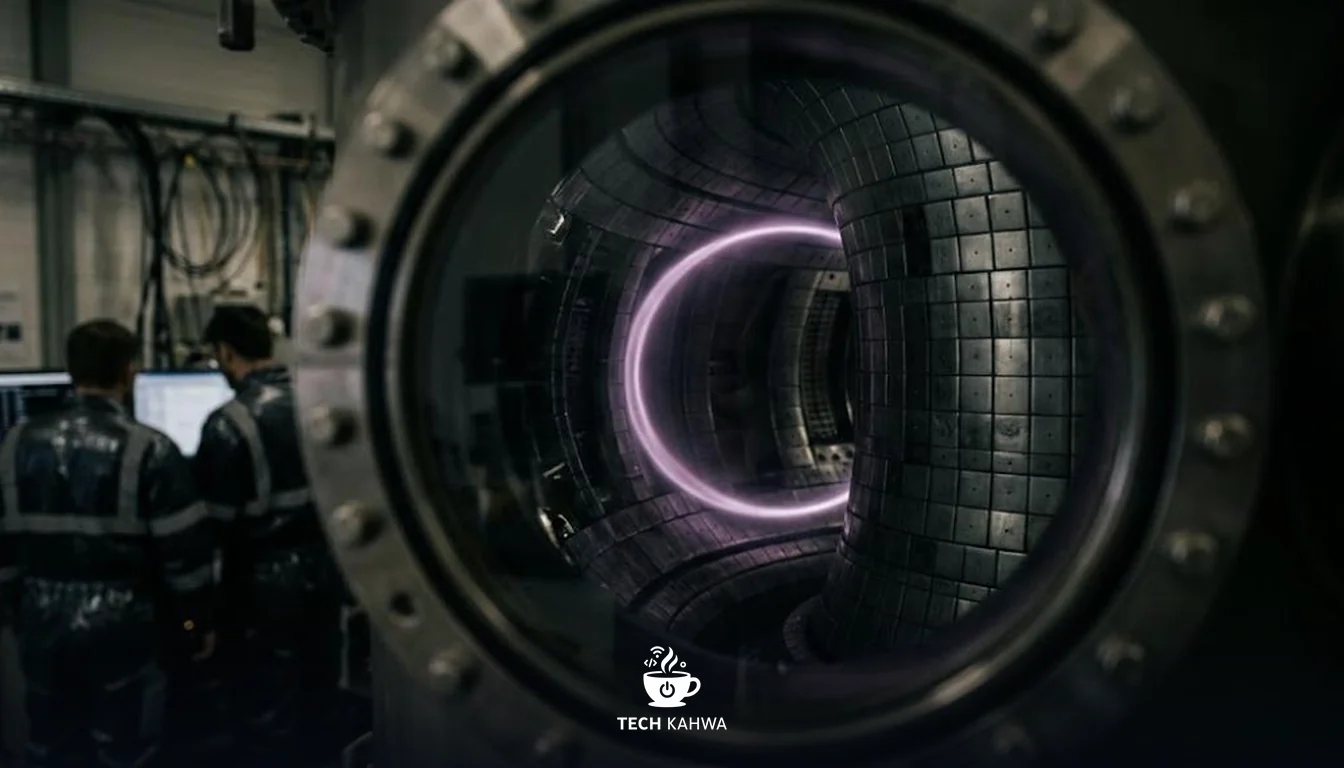
Researchers working on EAST, China’s experimental tokamak fusion device, report that they pushed plasma density well beyond the Greenwald limit, a ceiling that fusion scientists have treated as a practical boundary for decades. According to their paper in Science Advances, published on 1 January, EAST reached densities between 1.3 and 1.65 times the Greenwald limit, using a new way of starting up the plasma.
What happened
The study, titled “Accessing the density-free regime with ECRH-assisted ohmic start-up on EAST”, appears in Science Advances, Volume 12, Issue 1. It describes experiments in which the team kept the plasma running at densities that tokamaks usually avoid, because going past the Greenwald limit tends to end badly for the plasma.
The key to the result is how the plasma was started. The team combined a theory called plasma-wall self-organisation (PWSO) with electron cyclotron resonance heating (ECRH) during start-up, with the aim of cutting the amount of tungsten from the reactor wall that ends up mixed into the plasma. The research team includes Huazhong University of Science and Technology and Aix-Marseille University in France.
What caught my attention is the phrase “density-free regime” in the title. The researchers are not only claiming they got past the limit once; they are arguing that under the right start-up conditions, the limit stops acting like a hard wall at all.
How it works
A tokamak is a doughnut-shaped chamber that holds a very hot, electrically charged gas, called plasma, in place with strong magnetic fields. Fusion happens when light atomic nuclei in that plasma collide hard enough to fuse and release energy.
More fuel packed into the same space means more collisions, so density matters a lot. The problem is that, in practice, tokamaks have a density ceiling. The Greenwald limit is an empirical rule, drawn from years of experiments rather than derived from first principles. Push the density past it and the plasma usually becomes unstable and collapses.
Here is an analogy that helps me. Imagine a stadium manager who learned from experience that crowds above a certain size always end in a crush at the exits. The number was never a law of nature; it was a pattern. If you change how people enter, spreading them out from the start, you might safely fit in more. EAST’s team changed how the plasma “enters”.
One suspected reason plasmas fail at high density is impurities. Atoms knocked off the inner wall, here heavy tungsten, drift into the plasma and radiate away its heat, cooling the edge until things fall apart. PWSO describes how the plasma and the wall settle into a balance with each other. By using ECRH, which heats electrons with precisely tuned microwaves, to help start the plasma, the team aimed to set up that balance in a way that keeps tungsten contamination low. With a cleaner plasma, the density could climb far higher before trouble started.
By the numbers
| Item | Figure | Source |
|---|---|---|
| Density reached | 1.3 to 1.65 times the Greenwald limit | Science Advances paper |
| Publication date | 1 January 2026 | Science Advances paper |
| Journal volume and issue | Volume 12, Issue 1 | Science Advances paper |
| Start-up heating method | Electron cyclotron resonance heating (ECRH) | Science Advances paper |
| Impurity targeted | Tungsten from the reactor wall | Science Advances paper |
Why it matters
Fusion output climbs steeply as density rises, so the ability to pack in more fuel safely is one of the keys to making fusion reactors produce useful amounts of energy. A ceiling on density is a ceiling on performance, and any credible way around it gets attention across the field.
It is important to be precise about what this result is. It is not fusion ignition, and it is not net energy gain. It is not a record for how long a plasma lasted or how hot it got either. It is a result about one specific barrier, density, and about a start-up method that seems to move that barrier.
In my view, that narrower framing makes it more interesting, not less. Big fusion headlines often blur together, but progress in this field usually comes from solving one stubborn engineering and physics problem at a time.
What comes next
The paper is now public, which means other fusion groups can examine the method and test whether the same start-up approach works on their own machines. The obvious open question is how well the “density-free regime” holds up in different tokamaks and at the conditions a future power plant would need.
For now, EAST has shown that the Greenwald limit may be less of a wall than many assumed, at least when the plasma is started the right way.
Sources
- Science Advances, “Accessing the density-free regime with ECRH-assisted ohmic start-up on EAST”, Vol. 12, Issue 1, 1 January 2026, https://www.science.org/doi/10.1126/sciadv.adz3040