
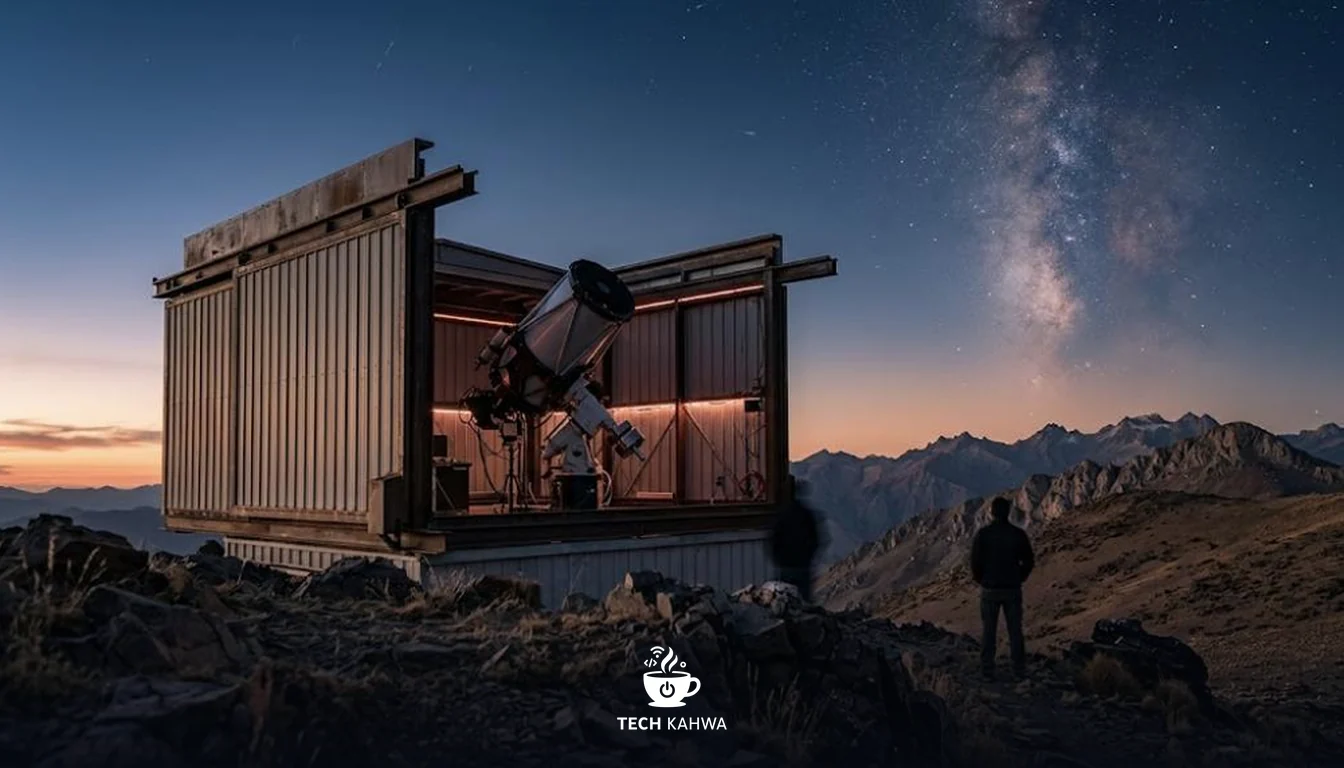
Rubin Observatory in Chile officially began its Legacy Survey of Space and Time on 30 June, a decade-long project to photograph the entire southern sky again and again with the largest digital camera in the world. Even before the survey started, test runs had already turned up more than 11,000 asteroids nobody had seen before.
What happened
Rubin sits on Cerro Pachón, a mountain in Chile, and yesterday it switched from preparation to its main job. The observatory calls the Legacy Survey of Space and Time, or LSST, a 10-year “movie” of the sky, and its director marked the start with a line that is hard to improve on: “Today, we begin filming the greatest cosmic movie ever made.”
This is not Rubin’s debut. The observatory had already shown its first images, the “First Look”, well before this week. What begins now is the long, systematic survey that the telescope and camera were built for.
The numbers are what make LSST different from almost any earlier sky survey. The camera has 3,200 megapixels and captures a new image approximately every 40 seconds. Each night produces about 10 terabytes of data and as many as 7 million alerts flagging something in the sky that has changed. Over ten years, each point in the southern sky will be observed roughly 800 times.
How it works
Most telescopes are pointed at a specific target that an astronomer has asked to study. Rubin works the other way around. It follows a planned pattern across the sky, night after night, and keeps coming back to the same patches. By comparing each new image with earlier ones, software can spot anything that moved, brightened or faded.
That is where the movie comparison comes from. A single photograph shows you a scene; a film shows you what happens in it. Rubin’s repeated images are the frames, and the changes between frames are the story: an asteroid crossing the field, a star that suddenly flares, a distant explosion that was not there a few nights ago.
The 7 million nightly alerts are that comparison turned into data. Each alert tells astronomers around the world that something changed at a particular spot, so they can point other telescopes at it quickly. The 10 terabytes a night are the raw material behind those alerts.
What caught my attention is how much the optimisation surveys found before the official start. Early runs spotted over 11,000 previously unknown asteroids, including 33 near-Earth objects and 380 trans-Neptunian objects, bodies that orbit beyond Neptune. That was essentially the warm-up.
By the numbers
| Item | Figure | Source |
|---|---|---|
| Survey start | 30 June 2026 | Rubin Observatory |
| Survey length | 10 years | Rubin Observatory |
| Camera resolution | 3,200 megapixels | Rubin Observatory |
| Time between images | About 40 seconds | Rubin Observatory |
| Data per night | About 10 terabytes | Rubin Observatory |
| Alerts per night | Up to 7 million | Rubin Observatory |
| Observations of each point in the southern sky | About 800 | Rubin Observatory and UW News |
| New asteroids found in optimisation surveys | More than 11,000 | UW News |
| Near-Earth objects among them | 33 | UW News |
| Trans-Neptunian objects among them | 380 | UW News |
Why it matters
Start with safety. A survey that photographs the whole southern sky every few nights for ten years is exactly the kind of tool that can find asteroids whose paths bring them near Earth. The 33 near-Earth objects found during testing are a small preview of that.
Discovery comes next. Exploding stars and other sudden events are, by nature, easy to miss if you are not already looking. Rubin is always looking, and its alert stream is designed to let astronomers react while an event is still unfolding.
Then there is the deepest question. Rubin’s decade of images will help researchers map dark matter and dark energy, two of the biggest unknowns in cosmology. Nobody expects a single image to answer that. The value comes from the sheer amount of repeated data.
In my view, the most interesting effect may be on how astronomy itself is done. When one instrument produces this much data every night, the bottleneck shifts from collecting observations to sorting through them.
What comes next
The survey now runs night after night from Cerro Pachón for the next ten years, and each night adds new frames to the record. For anyone who follows space news, this is a project to check back on often, because the sky it records will keep changing.
Sources
- Rubin Observatory, announcement of the start of the Legacy Survey of Space and Time, 30 June 2026, https://rubinobservatory.org/news/action-rubin-lsst-begins
- UW News, report on the start of the Rubin Legacy Survey of Space and Time, 30 June 2026, https://www.washington.edu/news/2026/06/30/rubin-observatory-legacy-survey-space-time-lsst/
- CNN, report on Rubin Observatory starting its Legacy Survey of Space and Time, 1 July 2026, https://www.cnn.com/2026/07/01/science/rubin-observatory-legacy-survey-space-and-time