
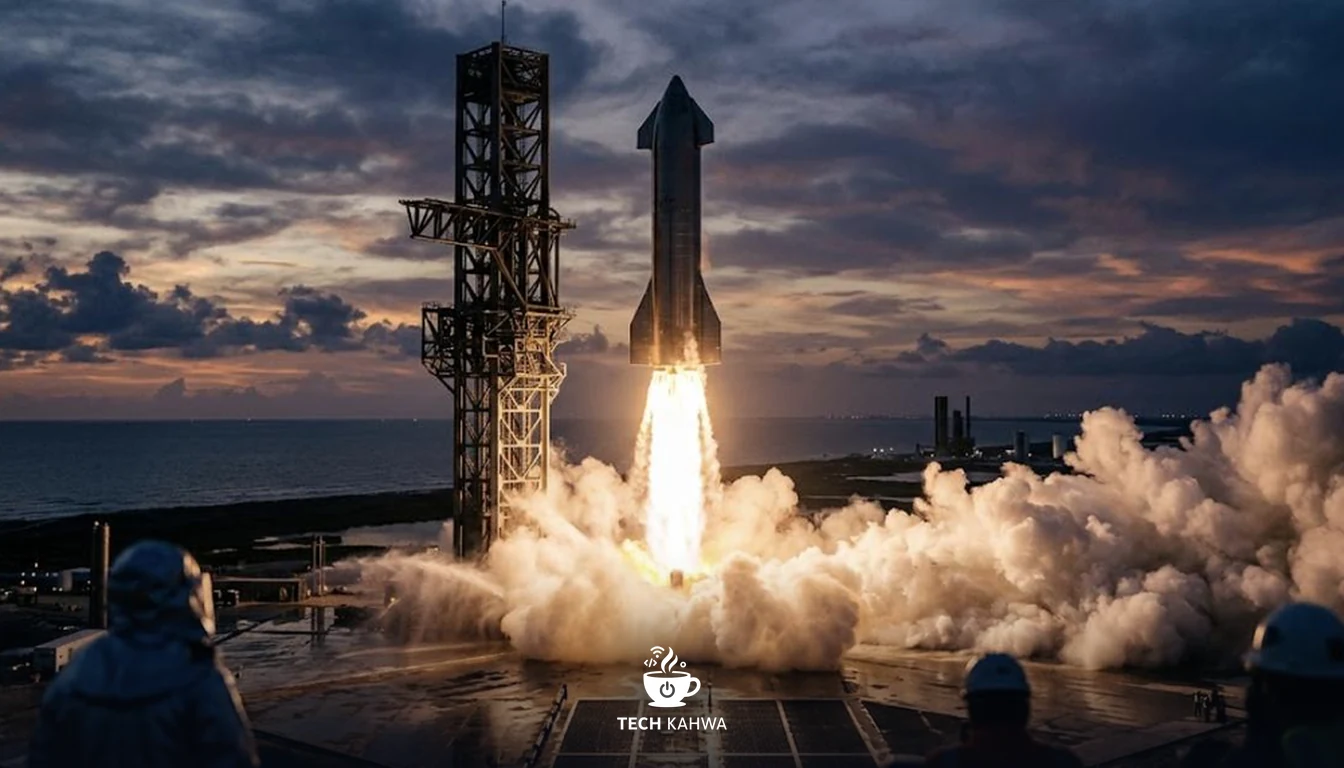
SpaceX launched the first Starship V3 at 2230 GMT on 22 May 2026 from the new Pad 2 at Starbase, a day after a scrubbed attempt. The ship reached space, deployed all 22 of its dummy Starlink satellites and made a planned splashdown in the Indian Ocean. The Super Heavy booster did not survive, crashing uncontrolled in the Gulf of Mexico.
A new rocket on a new pad
This flight carried a lot of firsts at once. It was the first Starship V3, it flew on Raptor 3 engines, and it was the first launch from Pad 2. When a company changes the vehicle, the engines and the launch site in a single mission, a clean result is a lot to ask for.
It almost started a day earlier. The first attempt on 21 May was scrubbed when a hydraulic pin on the tower arm did not retract. That is an unglamorous reason to stand down, and a useful reminder that a new pad is as much a test article as the rocket sitting on it.
How the flight went
The second attempt got off the pad. During ascent, one of the booster’s 33 engines went out. The ship, Ship 39, also lost one of its six engines on the way up, but it still reached space. That detail is the one I keep coming back to. Losing an engine and still making it to the planned trajectory is exactly the kind of margin a rocket designed to carry heavy payloads needs to show.
Once in space, Ship 39 deployed all 22 dummy Starlink satellites. They are mass simulators rather than working spacecraft, but the deployment itself is the thing being tested: the door, the dispenser and the sequence that will one day release real satellites in bulk.
The ship then came back through the atmosphere and made its planned splashdown in the Indian Ocean.
The booster story is less happy. Super Heavy crashed uncontrolled in the Gulf of Mexico. Reports so far do not agree on what went wrong, and I am not going to guess. SpaceX’s own analysis of the flight data will be the source worth waiting for.
By the numbers
| Item | Figure | Source |
|---|---|---|
| Launch time | 22 May 2026, 2230 GMT | Space.com |
| First attempt scrubbed | 21 May 2026 | Wikipedia |
| Booster engines out during ascent | 1 of 33 | Space.com |
| Ship engines lost during ascent | 1 of 6 | Space.com |
| Dummy Starlink satellites deployed | 22 | Space.com |
Why it matters
A first flight of a new version is judged differently from a routine mission. The question is not whether everything went perfectly. It is whether the new design did the core things it was built to do, and whether the failures are the kind engineers can learn from. On that measure, the ship half of this mission looks like a clear success. Reaching space with an engine out, releasing the full payload of dummy satellites and ending with a planned splashdown are all things SpaceX needed V3 to prove.
The booster is the open question. Super Heavy carries most of the energy of the launch, and losing one on a debut flight means the next steps depend on understanding exactly what happened.
For readers in the Arab world, two details stood out. The launch window meant a very late night: 2230 GMT is 1:30 a.m. on 23 May in Riyadh and 2:30 a.m. in Dubai, so anyone who stayed up to watch the stream earned it. And the ship’s journey ended in the Indian Ocean, the same body of water that touches the Arabian Peninsula’s southern and eastern coasts. It is a small thing, but it makes a very American programme feel a little closer to home.
There is also a longer view. Starship’s value depends on launching often, and a test payload of Starlink dummies shows which job SpaceX has in mind for it early on. Every flight that proves the deployment sequence brings that closer, and satellite internet is a service many readers in the region follow closely.
What to watch
- SpaceX’s review of the flight data, and in particular its account of what happened to the Super Heavy booster.
- How quickly Pad 2 is ready again after its first launch.
- Whether the next flight repeats the dummy Starlink deployment or moves on to new objectives.
Sources
- Space.com, “SpaceX Starship flight 12 launch updates” live coverage, 22 May 2026, https://www.space.com/news/live/spacex-starship-flight-12-launch-updates-may-22-2026
- Wikipedia, “Starship flight test 12”, accessed 23 May 2026, https://en.wikipedia.org/wiki/Starship_flight_test_12