
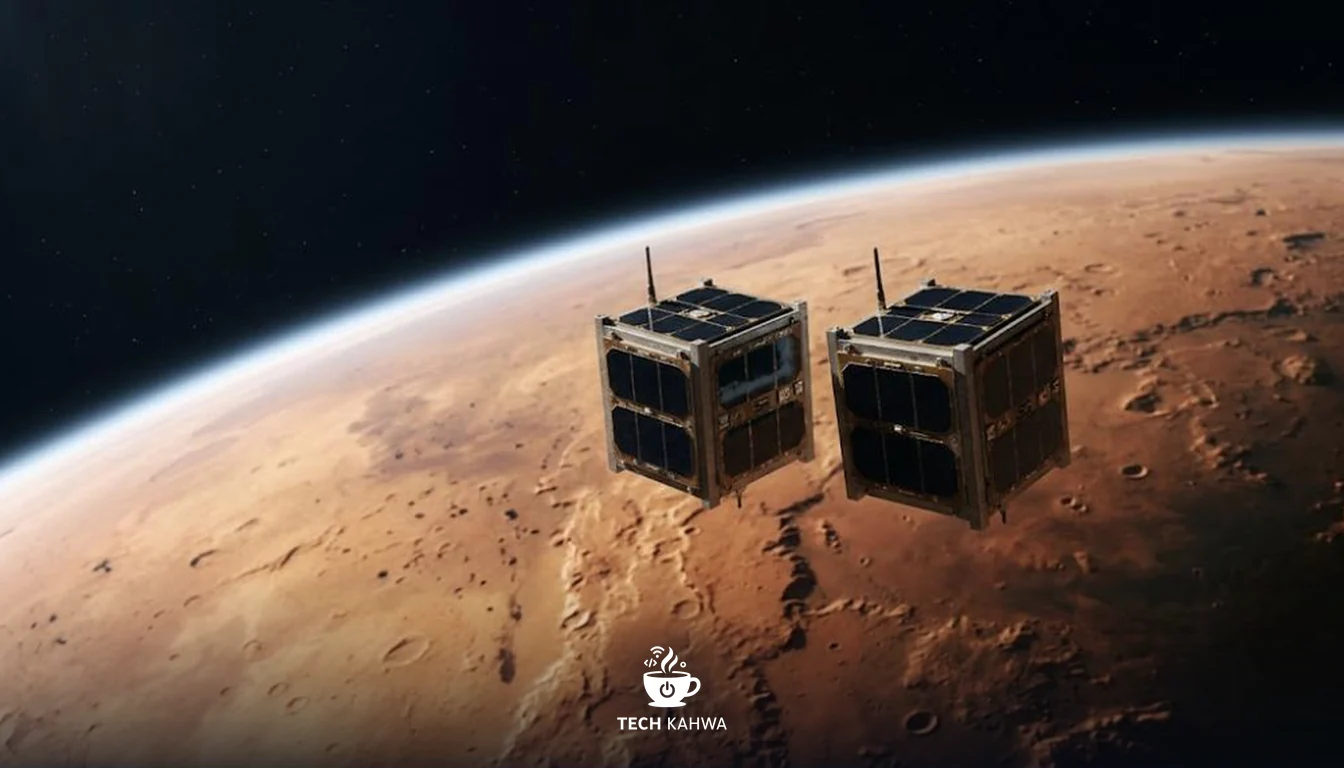
NASA’s ESCAPADE mission, two identical spacecraft built to study how the solar wind stripped Mars’ atmosphere, lifted off on 13 November aboard Blue Origin’s New Glenn rocket. The probes will not head straight for Mars: they will first park near a point a million miles from Earth and wait for the right moment to swing toward the Red Planet. On the same flight, New Glenn’s first stage landed on a ship at sea for the first time.
What happened
According to NASA, ESCAPADE “launched November 13, 2025, at 3:55 p.m. EST aboard a Blue Origin New Glenn rocket from Cape Canaveral Space Force Station” in Florida. The mission is led by the University of California, Berkeley, and the two spacecraft were built by Rocket Lab.
After sending the probes on their way, New Glenn’s first stage came back down and landed on Jacklyn, Blue Origin’s landing ship in the Atlantic. This was only the second flight of New Glenn, a mission Blue Origin calls NG-2, and the first time the company recovered the booster.
Two stories shared one launch here, and I think both deserve attention. One is a science mission with an unusual flight plan; the other is a rocket company reaching a milestone that makes future launches cheaper and more frequent if it can repeat it.
How it works: the long way to Mars
Normally, a Mars mission has to launch in a short window when Earth and Mars line up well. Miss it, and you wait a long time for the next one.
ESCAPADE takes a different approach. The probes first travel to Lagrange Point 2, which NASA describes as “a million miles from Earth”. A Lagrange point is a spot where the pull of the Sun and Earth balance out in a way that lets a spacecraft stay roughly in place relative to Earth without spending much fuel.
Think of it as a car park outside a motorway on-ramp. Instead of racing to catch a narrow gap in traffic, the probes wait in the car park, and when the gap opens they pull out. In November 2026 the probes will come back past Earth and use its gravity as a slingshot to head for Mars, “arriving in September 2027”, according to NASA.
Once there, the science begins in earnest. The two spacecraft will measure the solar wind, the stream of charged particles pouring out from the Sun, and how it interacts with Mars. That interaction is the key to the mission’s main question, how Mars lost its air. With two probes watching at once, scientists can separate changes that happen over space from changes that happen over time, something a single spacecraft cannot do on its own.
By the numbers
| Item | Figure | Source |
|---|---|---|
| Launch time | 3:55 p.m. EST, 13 November 2025 | NASA |
| Number of spacecraft | 2 identical probes | NASA |
| Distance of first stop, Lagrange Point 2 | About a million miles from Earth | NASA |
| Earth gravity assist toward Mars | November 2026 | NASA |
| Planned arrival at Mars | September 2027 | NASA |
| Start of dual-spacecraft science at Mars | June 2028 | NASA |
| New Glenn flight number | Second flight, NG-2 | Blue Origin |
Why it matters
The science goal is a long-standing question: how did Mars go from a world that could hold a thicker atmosphere to the thin, cold place it is today? NASA says dual-spacecraft science at Mars, starting in June 2028, will be “a first for any planetary mission”. Having two identical instruments in different places at the same moment gives a much richer picture of how the solar wind strips gas away.
The flight plan matters too. If parking a spacecraft near Lagrange Point 2 and waiting works well, future Mars missions will have more flexibility over when they launch. In my view, that trick could turn out to be as useful as the science itself.
Then there is the rocket. Landing a large first stage on a ship at sea means it can potentially fly again. For NASA and other customers, more reusable heavy rockets on the market means more options to reach deep space.
What comes next
The probes are now on their way to Lagrange Point 2, where they will spend the coming months before the planned Earth flyby in November 2026. If all goes to plan, they reach Mars in September 2027, and the paired science campaign begins in June 2028.
For Blue Origin, the recovered booster is the next thing to watch: inspecting it and preparing it for another flight is the real test of reuse.
Sources
- NASA, “NASA, Blue Origin launch two spacecraft to study Mars solar wind”, 13 November 2025, https://www.nasa.gov/news-release/nasa-blue-origin-launch-two-spacecraft-to-study-mars-solar-wind/
- Blue Origin, “New Glenn launches NASA ESCAPADE, lands fully reusable booster”, 13 November 2025, https://www.blueorigin.com/news/new-glenn-launches-nasa-escapade-lands-fully-reusable-booster