
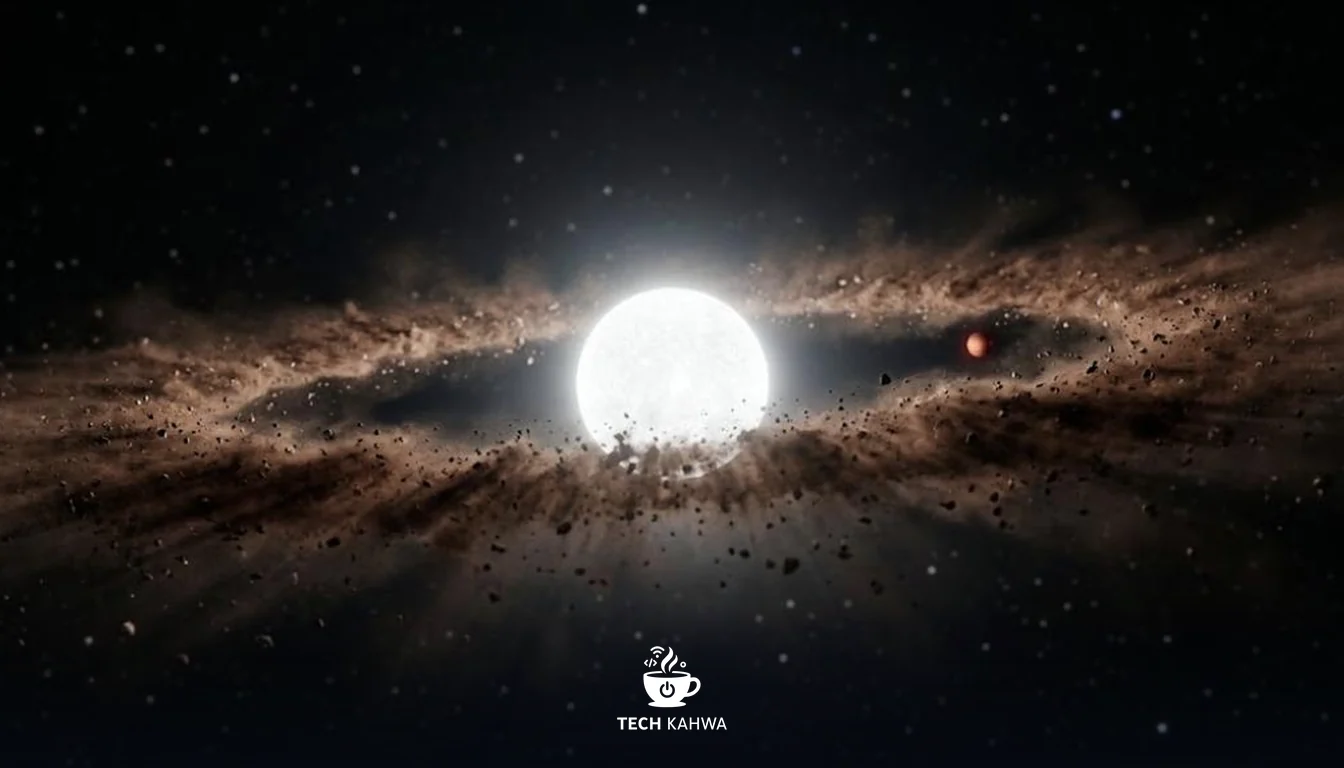
Astronomers using the James Webb Space Telescope have found a third giant planet in the Beta Pictoris system, a famous young star system. The surprise is how they found it: not by seeing the planet, but by reading the chemical fingerprint of its atmosphere.
What happened
NASA announced the discovery of Beta Pictoris d on 15 July 2026, the same day the study was published in the Astrophysical Journal Letters. The system is located 63 light-years from Earth and is about 23 million years old, which makes it very young by the standards of stars and planets.
The new planet is likely at least two times the mass of Jupiter and circles its star at about 30 astronomical units, meaning roughly 30 times the distance between Earth and the Sun. It joins two giant planets already known in the system, which is why it carries the letter d.
The most human part of the story comes from the lead researcher, Aidan Gibbs: “We weren’t looking for a new planet. We were trying to understand one we already knew existed.” That line caught my attention, because it describes how a lot of real discovery happens. You point an instrument at a question you think you understand, and the data hands you a different one.
How it works
Beta Pictoris is surrounded by a dusty debris disk. That dust is a problem for planet hunters. A young planet sitting inside it can be drowned out by the glow of the star and the scattered light of the disk around it, so ordinary imaging can miss it.
Webb’s team used a different approach. NIRSpec, one of Webb’s instruments, has a mode called the Integral Field Unit, which records a full spectrum of light for every point in its field of view. A spectrum splits light into its component colours, and molecules leave dark lines at very specific places in it, each molecule with its own pattern.
Think of it like a barcode. The star and the dust have one barcode; a planet’s atmosphere has another. In the data, the team spotted “a distinctive pattern of carbon monoxide absorption lines” that did not belong to the star or the dust. That pattern pointed to a planet.
Once they knew where to look, they turned to MIRI, Webb’s mid-infrared instrument, which “detected water vapor and methane”. Finding more molecules in the same place strengthened the case that this is a real planet with its own atmosphere rather than a quirk in the data.
By the numbers
| Item | Figure | Source |
|---|---|---|
| Announcement and publication | 15 July 2026 | NASA Science |
| Distance of the system from Earth | 63 light-years | NASA Science |
| Age of the system | About 23 million years | NASA Science |
| Mass of Beta Pictoris d | Likely at least 2 times Jupiter | NASA Science |
| Orbital distance from its star | About 30 astronomical units | NASA Science |
| Molecule used to find it | Carbon monoxide, with NIRSpec | NASA Science |
| Molecules confirmed by MIRI | Water vapour and methane | NASA Science |
Why it matters
The first thing to be clear about is what this is not. It is not Webb’s first exoplanet, and it is not a sign of life. Water vapour and methane in the air of a gas giant at least twice as heavy as Jupiter are clues to its chemistry, not to biology.
What it does show is a new way to find young worlds. Here the planet revealed itself through the molecules in its atmosphere, in a place where dust made a direct picture difficult. In my view, that matters more than the single planet, because it gives astronomers a method they can apply to other dusty young systems.
It also improves the picture of Beta Pictoris itself. A system about 23 million years old is still in the process of settling down, and knowing it holds at least three giant planets gives researchers a fuller system to study as it takes shape.
What comes next
The study is now public in the Astrophysical Journal Letters, which means other teams can examine the data and test the interpretation. The planet’s exact mass is still open; for now, the published estimate is only that it is at least twice as massive as Jupiter. Pinning that down, and learning more about the atmosphere Webb has already sampled, is the natural next step.
Sources
- NASA Science, article on Webb discovering a hidden planet in a famous star system, 15 July 2026, https://science.nasa.gov/missions/webb/nasas-webb-discovers-hidden-planet-in-famous-star-system/
- Space Telescope Science Institute, news release 2026-126 on Beta Pictoris d, July 2026, https://www.stsci.edu/contents/news-releases/2026/news-2026-126
- Max Planck Society, news item on a new planet in the Beta Pictoris system, July 2026, https://www.mpg.de/26864837/a-new-planet-in-the-beta-pictoris-system